Listed first is David Bowie’s debut album, curiously/mysteriously entitled…
I kid, I kid.
A while back and shortly after the passing of Mr. Bowie, I found and posted my own opinions about a list raking every David Bowie album released (minus collaborations and soundtracks).
In my posting, I stated:
Frankly, I feel David Bowie (Mr. Bowie’s first album) is probably the least of the works he has released. Let’s face it, with David Bowie we were dealing an album that was released when Mr. Bowie was an amateur without a solid direction.
This would also go, somewhat, with his next album, Space Oddity. While that album did feature the incredible -and drop dead classic- title song, most of the rest of the songs on that album are simply not all that great.
While this Rolling Stone magazine list is interesting, it does bring focus to something that should be clear: The art of creation is a sometimes bumpy one. It is rare that a person -or band for that matter- absolutely crush it with their first formal works/releases.
That’s not to say all first works of musicians are garbage. There have been others, ironically enough, who get some hits early on and, subsequently, can’t match the creativity of this initial outing.
Still, if you’re interested in reading up on what Rolling Stone considered some first album misfires, give the list a (ahem) whirl.
Moving away from the depressing subject of politics (click here if you want to be depressed…or simply scroll to my previous blog entry), yesterday I was delighted to find that the soundtrack to John Carpenter’s original 1976 Assault on Precinct 13 was available for purchase…so I purchased it.
I love, love, LOVE the original Assault on Precinct 13 and consider it one of John Carpenter’s all time best films even though it was clearly a very low budget affair and some of the acting was…well…not that great at points but enough to get the job done.
A classic “B” movie thriller with an equally classic John Carpenter electronic score. If you like this…
During their ultimately very short career as a band (hard to believe between the release of their first album, Please Please Me in 1963 and their last official release, Let it Be in 1970), The Beatles revolutionized Rock ‘n Roll.
Seven years. An astonishing twelve albums (Including 1969’s Yellow Submarine, which was more like 1/2 Beatles and 1/2 producer George Martin album). Add to that a very large number of mind-bogglingly good singles, now collected in Past Masters Volume 1 and 2. And they also found time to write songs for other bands/artists.
Truly an incredible burst of creativity, given how many of the songs produced during that short time were absolute classics.
Another fascinating thing about The Beatles was their evolution. The early Beatles music owed a clear debt to the 1950’s rock scene but in and around the time of the release of Help! (1965) it was clear things within the band were changing and their musical direction, in my opinion, soared.
I happen to be a fan of the second half of The Beatles’ career more than the first, though there are some great songs to be found in the early going. With Help!, The Beatles displayed some early examples of that second stage brilliance. Within that album, which was actually a soundtrack plus for the film of the same name, you find such tracks as You’ve Got To Hide Your Love Away, Ticket to Ride, and Yesterday, among others.
Their follow up album, 1965’s Rubber Soul, is considered a stone cold classic and the one that follows it, 1966’s Revolver, is considered by many the all-time best Beatles album ever. (Incredibly, they would follow that album in 1967 with Sgt. Pepper’s Lonely Hearts Club Band).
There are those that consider Rubber Soul and Revolver a “double album” that just happened to be released as two separate albums and I can’t argue the point.
Focusing on Revolver, that album featured some very strong works by the band, including such classic songs as Taxman, Tomorrow Never Knows, Yellow Submarine, and She Said She Said (one of my all time favorite Beatles songs).
There is another song on this album, Eleanor Rigby, which many consider one of the more unique -though still incredible- Beatles songs.
Hunter Davies wrote this article and presents a piece of an interview he conducted with Paul McCartney (the song’s primary writer) soon after the song was released about what went into the making of it and its possible meanings:
For those unfamiliar with the song (shame on you!):
A very fascinating article which, in a way, shows just how quickly things came together for The Beatles and how they -there was more of a sense of collaboration then- would knock off a song together.
After the incredible rendition of the National Anthem at this past Super Bowl, I was curious to see/listen to Lady Gaga’s tribute to David Bowie at yesterday’s Grammys.
The current music scene, to me anyway, is akin to watching a foreign movie without subtitles…For the most part I don’t understand it at all. (Get off my lawn!!)
After the show was nearly over I headed to YouTube and found the Lady Gaga tribute in its entirety (this morning, however, I’m seeing the tribute has been washed from YouTube and, instead, we get plenty of reviews of it).
My thoughts on what I saw?
I didn’t like it much. In fact, I shut it off after a couple of minutes.
Don’t get me wrong, I know Lady Gaga put a great deal of effort into the production and she certainly tried hard to get as many of Mr. Bowie’s “hits” presented in bit sized fashion as quickly as she could. It is also obvious she has a great deal of admiration for Mr. Bowie. I’ve always felt that she, and Madonna for that matter, are among the artists who most directly copied/adapted David Bowie’s evolution of style into their acts. Though they may have copied Mr. Bowie in that respect, they also brought powerful songwriting/singing skills to the mix which allowed them to not just copy Mr. Bowie’s style but also find their own and soar in their own directions.
Having said that, the Lady Gaga tribute was…it was cheesy.
That word screamed to my mind as I watched all I could handle before turning it off after a minute or two. Despite the great makeup and clothing and computer graphics what you had was basically a “best of” version of David Bowie’s hits/styles and it felt too curt and rather…depressing.
By giving us small samples of his songs while changing clothing every few seconds to mimic some Bowie style, it felt like we were getting some Vegas version of Mr. Bowie’s career. It was not unlike seeing Peter Frampton and the Bee Gees do The Beatles in the dreadful Sgt. Pepper’s Lonely Heart’s Club Band movie.
Please understand, I’m not a Lady Gaga “hater”. I’ve heard some of her popular songs on the radio and, frankly, like them for the most part even though I’m hardly into today’s music “scene”. I also recall hearing her on Howard Stern a while back, singing a couple of her songs with only her piano to accompany her and was blown away by how good she sounded. Hell, as I mentioned above, I absolutely loved her National Anthem rendition.
Found this article, written by F50!! and posted at “Talk Amongst Yourselves” offers a ranking for all 24 of David Bowie’s albums (minus collaborations or soundtracks) from best to what he considers the worst:
As with any sort of ranking of this kind, the judgment is in the eye of the beholder. For example, I wouldn’t agree with his ranking of Reality, Hours, Earthling, and Young Americans as being quite as low as he states they are.
Frankly, I feel David Bowie (Mr. Bowie’s first album) is probably the least of the works he has released. Let’s face it, with David Bowie we were dealing an album that was released when Mr. Bowie was an amateur without a solid direction.
Still, there are a couple of interesting songs to be found in his very early archives, including this one, also mentioned by the author of this article…
I would then put Space Oddity, Mr. Bowie’s second full album, as the next on the list. For certain there are a couple of very good songs to be found here, including the all time classic which the album was named after and The Wild Eyed Boy From Freecloud, which Mr. Bowie noted in an interview was the first song which he considered a proper “David Bowie” song…
From there I’d go with Never Let Me Down, a very disappointing album that nonetheless also featured some good songs but…well, it just felt like Mr. Bowie was alternately trying too hard and not hard enough to create another “hit” album. A big disappointment.
From there, its up to everyone’s own taste, IMHO, where each album lies. But of the albums released (and going by the list provided here, eliminating soundtracks and collaborations), what would be my top 5 David Bowie albums?
For as big a fan as myself, this is not an easy task.
But here goes (and they are presented in order of release and not preference. This list, by the way, reflects where my thought process is at the moment. A year from now, who knows?).
Regardless, you can’t lose, IMHO, with any of these five albums:
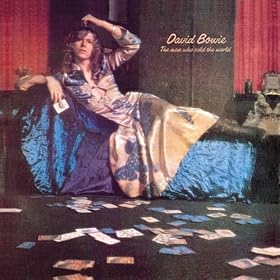
The Man Who Sold The World: I consider this the first “real” David Bowie album from start to finish. A dark, macabre work that came ages before, yet featured elements which would appear in heavy metal, goth, etc. etc. work to come years later. By now most people know the song which gave the album its title and it is one of David Bowie’s best. But also check out The Width of a Circle or Supermen or Saviour Machine, etc. A very strong album.
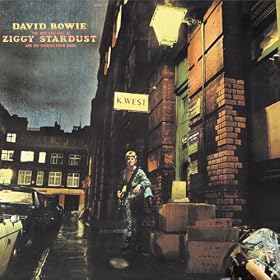
The Rise and Fall of Ziggy Stardust and the Spiders From Mars: Of all the albums David Bowie made, this is the one everyone will include on his top 5 release list and, further, likely put it at #1. Who am I to argue? Ziggy Stardust is an incredibly ambitious yet very “tight” album. It is one of the earliest concept albums ever created and involves a decaying, dying earth that is visited by an alien rock God named Ziggy Stardust. A terrific album with terrific songs from start to end. (By the way, the song All The Young Dudes, written by David Bowie but given to Mott the Hoople to record was originally intended to be a part of this album and fits on it very nicely. I suspect it would have fit in right after the album’s first song, Five Years. A David Bowie version of the song is available as well).
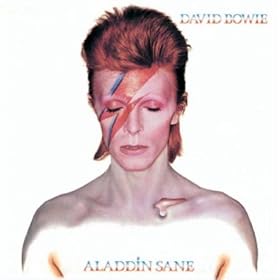
Aladdin Sane: Coming hot off the heels of Ziggy Stardust was that album’s follow-up/companion Aladdin Sane. Some have called the album “Ziggy Stardust comes to America” and they’re not far off the mark. While not quite as good as Ziggy Stardust, this album remains one of my all time favorites. I absolutely love Panic In Detroit, Drive In Saturday, Aladdin Sane, and the chilling Lady Grinning Soul.
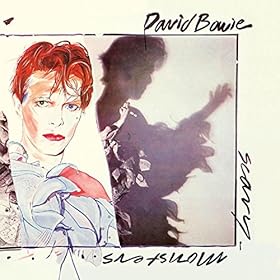
Scary Monsters (And SuperCreeps): I have to admit, though unintended, the last two albums in this list (this one and the next) could easily be substituted by any number of other great Bowie works. For example, I’ve not mentioned at all his wonderful Berlin Trilogy of Low, Heroes, and Lodger? Thought I know there are those who don’t like it that much, I absolutely love the admittedly more shallow/hit filled Let’s Dance. And what of Station to Station and Young Americans? And Hunky Dory and Diamond Dogs! How could they not fall somewhere on this list as well?! And that great final album, Blackstar! Where is it?! Well, as I said, this is my list and while those I just mentioned are terrific albums, they fall just a hair below this and the next album on my top 5 list. Scary Monsters is, like David Bowie’s best albums, ambitious in scope and features many different -and at times very wild- music choices. This is an album that is great from start to finish though I would point out the underrated Teenage Wildlife for special attention. Great stuff.
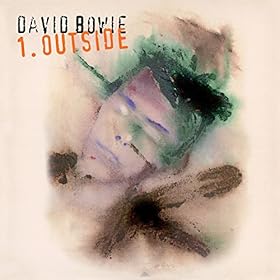
1 Outside: When this album was originally released in 1995, I was shocked by how much the critics hated it. In fact, there were very few (if any) I could find that actually liked the album. It was a weird experience because for me the album was nothing short of amazing and featured some incredibly strong tracks (I Have Not Been To Oxford Town, Thru These Architect Eyes, I’m Deranged, Heart’s Filthy Lesson, Strangers When We Meet, etc.) and a bizarre, almost Blade Runner/William Gibson-like sci-fi concept involving the end of the century. Over the years, it appears there has been a re-evaluation of this album and many people now seem to have recognized the album’s quality versus when it was first released.
Look, I’ll be blunt here: I can sorta understand where the original criticism came from. 1. Outside is a very overstuffed work. It features a plethora of songs and styles and there are oddball “segues” between many of the songs wherein a story is told by David Bowie using distorted voices. Yes, I can see where some might have felt this was all a little too much.
But that’s what makes the album so damn good! 1. Outside is an immersive experience and, if you’re willing to give it a try and roll with it, I promise you will be amazed. A great, great work.
*****
So there you have it, my all time favorite five David Bowie albums. Your mileage, as they say, might vary.
I’m loath to post the chart here as I want people to go to Mr. McCann’s website but I will say this: He breaks down the songs in a very interesting way, giving us an idea of how prolific each Beatles was, how many hit songs each (and in collaboration) had, and even which songs featured the most/least words in them!
Again, I don’t want to steal Mr. McCann’s thunder (and work) by simply cut and pasting his chart here.
If you’re a Beatles fan like I am, you’ll find the work fascinating.
I have the say, the question is trickier than one might think, given that there are some bands that sound very “American” and yet whose members (some or all) may be from other countries.
Mr. Leopold offers some interesting choices, among them (of course) The Eagles, The Beach Boys, Nirvana, Aerosmith, The Ramones, Tom Petty and the Heartbreakers, The Grateful Dead, etc. etc.
There is a reader voting offered at the end of his article and, of the bands offered, I’d probably choose The Doors as my favorite. In six albums they created a unique, eerie, haunting, and at times bluesy sound. Some of their songs were big radio hits…
They also created a few long, epic songs…
And toward the (ahem) end, shortly before lead singer Jim Morrison’s death, the toll of his abuse of drugs and alcohol ravaged his voice. And yet, even with his voice noticeably different than from his early days, it was nonetheless still more than good enough to serve up one of the group’s final, classic songs…
Six albums -and one live album- released between 1966 and 1971. A very high output and, in my opinion, a great body of work.
Wow. It just seems like suddenly so many famous people are passing away. In the music business alone we’ve had the recent deaths of David Bowie, Lemmy, Scott Weiland, Natalie Cole, Mike Porcaro (from Toto), Chris Squire (from Yes), Joe Cocker, and B. B. King.
Taking a step back, one notes that a part of this is aging. Several of those who have passed away were reaching/had reached their senior years.
Though many consider it a terrible movie (I don’t, although I also don’t believe it was a particularly great movie either) Indiana Jones and the Kingdom of the Crystal Skull offered a great line regarding growing older/aging. When Indiana speaks with Dean Charles Stanforth and laments the fact that he’s lost both his father and Marcus, the Dean replies:
We seem to have reached the age where life stops giving us things and starts taking them away.
While I’m still a ways from being a senior citizen (may that day arrive veeeerrrry slowly!), for a few years now I’ve noticed either the aging of actors/musicians/TV personalities/athletes who I saw/admired while in their prime and/or the passing of many of these figures.
To me, David Bowie, for example, is a man I envision from his Let’s Dance years. It was startling to see the elderly and, though I didn’t know it until he passed, infirm David Bowie present in the Blackstar and Lazarus videos. Similarly, when I think of Harrison Ford I see the young, vital man from Bladerunner or Raiders of the Lost Ark and not the older, much grayer Han Solo in the current Star Wars film’s commercials (haven’t seen The Force Awakens).
Returning to Glenn Frey, I’ll admit I never was a huge fan of The Eagles or Mr. Frey’s solo career but there is no doubt he, along with his Eagle bandmates, created a monster of an album with Hotel California and his solo career was a success as well. His passing, like Mr. Bowie’s, is nothing less than a shock and another sign of the inevitable passage of time.
The opening months of 2016 are filling me with nostalgia. Not only did I pre-order and just download the new David Bowie album Blackstar (formally released today, December 8th, the same day as Mr. Bowie’s -gulp!- 69th birthday) but I’ve also pre-ordered the upcoming Anthrax album For All Kings (release date: February 26th) and the Megadeth album Dystopia (release date: January 22). So far, the preview songs released from these later two albums have impressed me and, with regard to Megadeth in particular who I feel had become lost since Mr. Mustaine’s religious right conversion, that’s saying a lot (check out the song The Threat is Real. Whew!)
It’s rare that I want to buy one album in any given two month period of time, but three?
Getting back to David Bowie’s Blackstar, I’m usually hesitant to review an album in full until listening to it a few times. Songs you may not like at first may grow on you while others you like right away may wear out their welcome.
However, before downloading the full Blackstar album, Mr. Bowie pre-released two of its seven songs and I’ve heard them plenty of time. The first release was the song the album was named after, Blackstar…
…a little later came Lazarus, a song which supposedly is about Thomas Jerome Newton, the alien character Mr. Bowie played in the movie The Man Who Fell To Earth…
Having thoroughly vetted both songs, I really, really liked what I heard.
Given the album has 7 songs and I’d listened to two of them as well as a somewhat different version of a third song, Sue (or a Season in Crime), I’ve already heard nearly a third of the album before its official release so I feel more comfortable in giving my thoughts.
Here goes: This is one hell of an album.
The cliche regarding just about every new David Bowie release falls along the line of “his best work since Scary Monsters” or somesuch.
To some degree, I understand the sentiment. After the release of his immensely popular album Let’s Dance way back in 1983, Mr. Bowie hit a bump in the road, creatively. He followed up Let’s Dance with Tonight, an album that had a few good songs but felt like a half-hearted effort. He followed that up with the ironically titled Never Let Me Down, an album that also featured some good songs but, to my ears, appeared to be Mr. Bowie trying a little too hard to create a “hit” record. It’s little wonder Mr. Bowie himself feels this is the worst album he’s created.
After that album, Mr. Bowie tried his hand at hard rock/heavy metal (not as strange a concept as one might think) with Tin Machine. After that fizzled out, he released 1993’s Black Tie White Noise, an album that didn’t do all that much for me.
But what followed was magic.
Starting with 1993’s The Buddha of Suburbia and the absolutely excellent follow-up, 1995s 1. Outside, Mr. Bowie was suddenly on a roll.
Blackstar represents Mr. Bowie’s 8th album since the release of The Buddha of Suburbia and it is breathtaking how invested he appears in this particular work. It’s as if he’s found yet another new crack in the music landscape and is mining it for all its worth. His singing is soulful and the mere seven songs presented are emotional, vibrant, strange (in an oh-so-good-way), experimental (I’ve never heard anything from Mr. Bowie quite like Girl Loves Me, a song that sounds almost like…rap?!), and fulfilling, even more so than the critically acclaimed (and also quite good) previous album The Next Day.
When I was younger and just discovering Mr. Bowie, one of the greatest laments I had was the “what if” question of what might have happened if Mr. Bowie had continued with his Spiders of Mars bandmates, especially guitarist Mick Ronson. Might there have been more albums on par with The Man Who Sold The World or Hunky Dory or Ziggy Stardust or Aladdin Sane?
With the release of Blackstar the answer, which should have been evident before, becomes all the more clear: Because of Mr. Bowie’s nature and his drive to create different types of music, Bowie works best with musicians for a limited amount of time. His best stuff seems to come when he moves on to new musicians, as he transitioned from those early rock albums into the Berlin Trilogy, etc. etc. With Blackstar, Mr. Bowie has a new stable of musicians behind him, known mostly for their work in jazz, and it appears to have reinvigorated and renewed him.
Having said that, the music on this album isn’t so radically different as to not be recognizably David Bowie. In the song Blackstar, it would appear Mr. Bowie, to my ears anyway, has fused his very early work The WIld Eyed Boy From Freecloud…
…with Loving the Alien…
For Sue (or a Season of Crime) I get a distinct 1. Outside vibe, so much so that the song could easily fit on that album.
Regardless of the call outs or similarities, Blackstar is a terrific work from one of the most gifted musicians out there today.
If you’re a fan of David Bowie, buying Blackstar is a no-brainer. If you haven’t listened to any of David Bowie’s recent works, you’d do well to give it a try.
Sounds interesting. I have to agree with Mr. O’Leary that much of David Bowie’s oeuvre does hint at his desire to have a musical, from his earliest works to his many theatrical transformations. Now, heading into the twilight of his career, it would appear he finally has his musical show and, at least based on this review, it appears to be a culmination of all things Bowie and set on stage.
Is that a good thing?
I wonder. I also wonder if I’ll get a chance to see it…