Category Archives: Music

Scott Weiland, RIP

Fame is so fleeting.

The other day while looking around Amazon.com I noticed there was a deluxe edition release, to coincide with its 20th anniversary, of Alanis Morrissette’s Jagged Little Pill.

For those who weren’t around at the time, the best description one can make regarding the explosion of sales, interest, and radio play from the songs on that album and at that time was very much akin to the current release of Adele’s 25.  But unlike Adele, Alanis Morissette appeared to come out of nowhere and each new song pulled from that album did just as well, or better, than the last.

Mrs. Morissette continued her musical career -even to this day- but none of her subsequent releases captured the public’s imagination quite like Jagged Little Pill.

That decade, the 1990’s, were also the era of “grunge” rock and Nirvana was arguably at the top of the heap though there were other bands whose style was looked at as in Nirvana’s “vein”.  Some had modest success, others none at all.  One of the bigger bands to emerge during that time and in Nirvana’s wake was Stone Temple Pilots.

Their first album, released in 1992, was Core.  Featuring Scott Weiland on vocals, the album was a hit and featured songs such as Plush

…and Creep

Their follow up album, Purple, featured what to me is their absolutely best song, Interstate Love Song.  I recall driving around one day and listening to a local radio station.  It played this song and I was enraptured by it.  I didn’t have the -gasp!- CD at the time but resolved at that moment to buy the album the first chance I had.  When the song reached its end, I was bummed.  I wanted to hear it again!  Incredibly, when the DJ came on after the song was over, he said: “Sorry, I have to hear this again” and proceeded to play the song a second time!  One of the few times in my life a wish was granted…

The group would release a third album in 1995 titled Tiny Music…Songs From The Vatican Gift Shop, which featured songs such as Lady Picture Show

The band was a great success but bad things were happening behind the scenes.  It was becoming common knowledge that lead singer Scott Weiland had drug problems.  In fact, after the release of that third album the band went on something of a hiatus, reformed, then eventually divorced themselves from Mr. Weiland and re-formed with another singer.  Mr. Weiland would go on to sing for Velvet Revolver and, at the time of his passing, The Wildabouts.

He was only 48 years old.

I go into this history not to diminish Mr. Weiland and the troubles he faced but rather to recall the joy he and his band gave me with those initial three albums.  While I admit I wasn’t that big of a fan of Mr. Weiland’s post-STP work, those three albums worth of songs, and most especially Interstate Love Song, are near and dear to me.

Therefore it’s a great pity to hear that someone who gave you so much joy is gone.  Mr. Wieland was a great talent, this is true, even if he was also faced difficulties in his personal life.  My condolences to his family and friends.

As for me, I’ll go play Interstate Love Song once again.  Then maybe repeat it a few more times.

Rest in Peace, Mr. Weiland.
It’s all about timing…

Consider me an Adele fan.

When “Hello,” the first single from her new album popped up on the radio and I first heard it, I found myself choked up with emotions.  She really knows how to hit a nerve…

But as with just about every artist struggling to get their works known, talent is but one ingredient in the mix and sometimes success is just as much about timing.

Which brings us to this seemingly oddball article which notes how…

Sarah Palin Sends Very Mushy Thank You Note to New BFF Adele

So you think: What in the world could Sarah Palin (an at best ridiculous figure, IMHO, in politics) and Adele possibly have in common?!

Turns out in 2008 Sarah Palin, during her failed run as the Vice Presidential Candidate to John McCain, appeared for the first time on Saturday Night Live, in the cold opening, to considerable -and massive- audience interest/viewership.  And who do you suppose was the guest musical artist for that particular episode of SNL?

You guessed it: Adele.

At the time she was an almost complete unknown and promoting her first album, 19.  Because of the large viewership of that episode (the episode had one of the largest in SNL’s history), Adele snagged a very large audience to hear her sing and, clearly, they liked what they heard.  Even more luck was on her side as the Billboard ballots were due two weeks from that date and many clearly her songs in mind…

The rest, as they say, is history.

While it is very conceivable because of her incredible talent Adele would have achieved her success anyway, one cannot and should not discount the benefits she reaped from her well-timed appearance on SNL all those years ago.

Blackstar…

A 10 minute long music video featuring “Blackstar”, David Bowie’s newly released single (the full album lands in early January, 2016)?

Yes please!

Fascinating, eerie, different…to an extent.  It did echo/remind me of this song/video:

Someone far smarter than me noted that on “Blackstar” David Bowie returns to the “Major Tom” mythology, this time presenting our errant astronaut -or rather his remains!- as a religious totem.

As with “Loving the Alien”, with “Blackstar” it would appear Mr. Bowie is again examining, in his own inimitable way, religion.  While I believe he may be an atheist (in interviews he has hinted at this fact, if my memory is correct), he is obviously deeply fascinated with religious ideology and mysticism.  He’s released many songs and even full albums which have, again in his own way, dealt with philosophical/religious ideas.  With “Blackstar” it would appear he’s once again looking in on this issue.

Fascinating stuff.

On Creation…

A couple of days ago in the blog post Crediting Bill Finger I stated Mr. Finger, while very much deserving of finally being acknowledged as a co-creator of Batman, isn’t the only one that should be credited.  I pointed out that Shadow author extraordinaire Walter B. Gibson also might deserve some credit as Mr. Finger and company, when they wrote the very first Batman story which appeared in Detective Comics #27 essentially made a comic book adaptation of one of Mr. Gibson’s Shadow stories.  While this was one (and the most obvious) of the Gibson written Shadow stories that clearly influenced Mr. Finger, I nonetheless feel I came off waaaay too glib in my posting and for that I apologize.

The fact is that while the very early Batman stories may have cribbed certain ideas (and even complete stories) from The Shadow works by Mr. Gibson, the Batman character and his world quickly moved off into other very fascinating and often unique directions.  While Mr. Gibson and some of his Shadow novels were an inspiration at the start of the Batman series, so too were other works and, again, Batman would go off into its own unique direction and for that Mr. Finger richly deserves the lion’s share of the credit for what he did.

I suppose the above should clue you in on the fact that I’m incredibly fascinated with artistic creation(s) and the credit deserved for them.

Perhaps one of the most interesting of the “creator” issues, to me, is that regarding author Alan Moore and arguably his most recognized creation, Watchmen.

Back in the 1980’s author Alan Moore became a superstar writer, and deservedly so, for his work on Marvel (later Miracle) Man, V for Vendetta, and Swamp Thing.  Watchmen would come at the tail end of his association with DC Comics in the form of the 12 issue limited series.  Watchmen explored the dark side of what the world would be like with Superheroes.  It was subsequently made into a film…

It was because of what followed after the release of this series that Mr. Moore had a major falling out with DC Comics and left the publisher never to return.  My understanding of the situation, based on interviews Mr. Moore gave after the fact, was when he and DC Comics came to an agreement about publishing Watchmen the contract specified that once the series was out of print, something which Mr. Moore expected to happen rather quickly, the rights of this series would revert to Mr. Moore and artist Dave Gibbons.  However, Watchmen proved an incredible success and DC has been able to keep reprinting it since its first publication in 1986.  I’ve read there were other issues which caused Mr. Moore’s ire as well regarding royalties, but I don’t know enough about them to comment.  Suffice to say Mr. Moore’s anger toward DC stemmed to a large degree over the fact that he lost control of Watchmen when he thought it would come to him soon after the initial publication.

When Mr. Moore left DC Comics in 1989 it was with considerable rancor and, as an author I could sympathize with his desire to control his own works.

But we’re talking about creative credits here and this is where certain facts rear their heads.

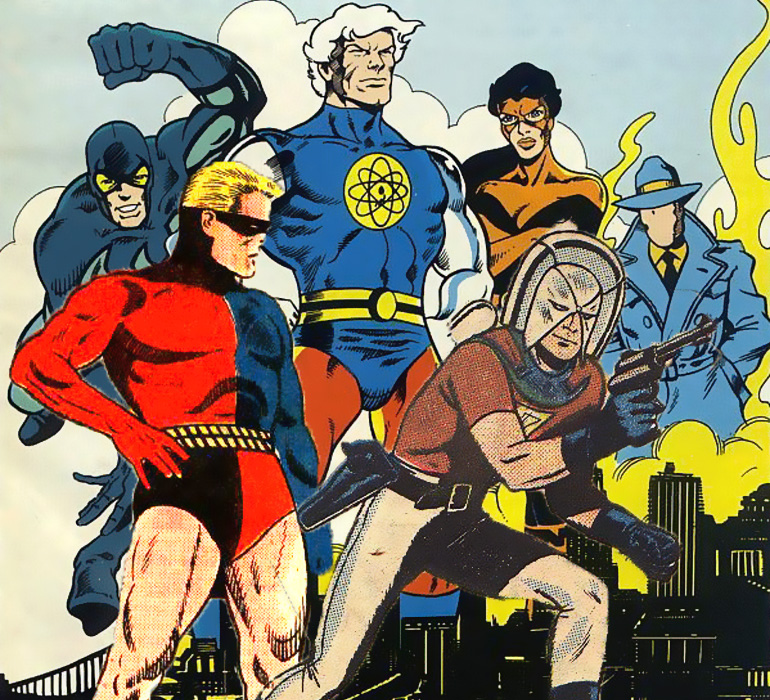
To begin, Mr. Moore originally conceived Watchmen as a story which would feature the various Charlton superheroes that DC Comics had at that time acquired.  Below is an image of those various Charlton Characters.  From upper left and moving clockwise you’ve got The Blue Beetle, Captain Atom, Nightshade, The Question, The Peacemaker, and Peter Cannon/Thunderbolt.

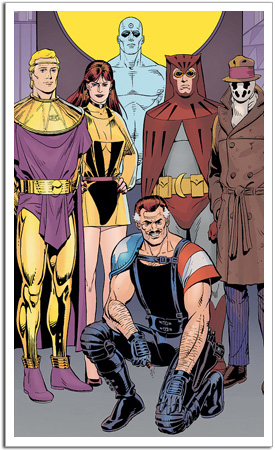
And here we have the principle cast of Watchmen.  From left and moving clockwise, you have Ozymandias (Peter Cannon), Silk Specter (Nightshade), Doctor Manhattan (Captain Atom), Nite Owl (The Blue Beetle), Rorschach (The Question), and The Comedian (Peacemaker).

Mr. Moore’s concept for a Charlton based Watchmen proved difficult for DC Comics to accept as the story was self-contained and ended in such a way it would be difficult to re-use the recently bought characters in any other way.

Therefore Mr. Moore modified the established Charlton characters into these “new” characters and the series was greenlighted and published.

Mr. Moore’s story, unquestionably, was “his” concept, a darker take on what would happen in the real world if Superheroes existed.  He had already begun that process with Marvel (Miracle) Man and Watchmen was the culmination of that theme (I’ll ignore the climax of the book and its too-striking resemblance to the Outer Limits episode The Architects of Fear because it is my suspicion this might have been nothing more than an innocent coincidence).

The facts tell us that while Mr. Moore is clearly the creator and writer of the Watchmen story, every one of the characters he used within them were thinly veiled versions of other authors/artists creations.  Which makes me wonder: Should the creators of the various Charlton heroes which were the basis of the Watchmen characters not be entitled to some kind of recognition -and perhaps even monetary compensation- for the characters they created and Mr. Moore essentially appropriated?

Further, because the project was initiated because DC Comics purchased the Charlton characters and those were the ones that provided the impetus to Mr. Moore’s story, don’t the people behind that purchase also deserve some credit for bringing these characters to Mr. Moore’s attention and use?

I suppose what I’m trying to say is that sometimes –sometimes– creative credit is a harder thing to assign than it at first seems.


A little more on those Led Zeppelin remasters…

The last three albums released by the legendary rock group, Presence, In Through The Out Door, and Coda, have been re-mastered and re-released with bonus material and I took advantage and picked up In Through The Out Door and Coda, though this time via digital download,

When they were at their height of creativity, Led Zeppelin seemed unable to do any wrong.  These last three albums, unfortunately, point out that the creative spark that began and burned so bright on the first six Led Zeppelin albums dimmed somewhat as the band reached its end.  (I say somewhat because even these albums, which I consider lesser works compared to the six that came before them, nonetheless feature some absolutely great tunes)

It was inevitable, I suppose.

Offhand, I can’t think of any artist whose entire career and works produced was uniformly good and/or great.  Hell, Steven Spielberg, one of the today’s greatest living directors, made an incredible splash with Duel, a film I consider one of his all time best works and a clear “first draft” of his first huge hit, Jaws.  Yet the film he followed Duel with in 1972 was the flat out boring Something Evil.

When Led Zeppelin formed, it consisted of both experienced studio folk and newcomers who, together, were a hit from the word go.  Their first six albums, released between 1969 and 1975, are considered by many music lovers to be uniformly excellent and each album carries a mind-boggling amount of classic, very well known songs.

But after the release of 1975’s phenomenal double album Physical Graffiti, Led Zeppelin’s 1976 follow-up, Presence, was a more muted affair.  Yeah, the album did have great songs like Achilles Last Stand, but it felt like the band was, for the first time, running in place.  The same most certainly couldn’t be said for In Through the Out Door, though there are few that would place that album among Led Zeppelin’s best.  Released in 1979, this album featured the band moving into other directions and using more synthesizer than most were accustomed to hear.  When Coda, their final album, was released in 1982, it was clear this album was a contractually obligated one consisting of discarded tunes that couldn’t find their way into other albums.  By the time of that album’s release, it had been two years since drummer John Bonham passed away and the band was, for all intents and purposes, dissolved.

So what happened to Led Zeppelin in their later years?  How did they go from creative powerhouse to something lesser?

Perhaps they had exhausted their initial creative spark.  They had, after all, released a tremendous amount of material in a very short period of time and it was only natural they might exhaust their ideas.  Another possible factor, sadly, is the alleged drug/alcohol abuse of several of the band members.  It was shocking to me to compare photographs of the band from 1971-3 to photographs from three to four years later.  Clearly several of the band members look far more aged than they should be given the brief time that has passed.

A third factor is the evolution of music.  By the mid-1970’s, the music scene was evolving, as it always does, and the members of the band may well have realized they needed to move on from their trademark heavy rock/blues and try out other forms of music.  David Bowie made a career through the 1970’s and 80’s of pursuing then abruptly changing musical styles.  So too Led Zeppelin tried to change and, with those final albums, introduced more synthesizer heavy songs, country-esq music, and even a calypso/raggae sound.

Did these experiments work?

Not always.

Focusing on the two albums I bought, In Through the Out Door features some great songs such as In The Evening

The album also featured what may be one of the all time worst Led Zeppelin songs in the country-esq Hot Dog

Still, even that song has its charms even though it feels really wrong coming from this band.

The final Led Zeppelin album re-release, the out-take filled Coda, nonetheless proved to be the most interesting vis a vis outakes/cut songs.  In my previous post regarding the Led Zeppelin re-releases (you can read it here), I lamented the fact that in the two albums I had previously bought, Led Zeppelin IV and Houses of the Holy, the bonus material simply wasn’t all that impressive and/or different from the songs ultimately released.

With Coda, I can’t make that complaint.

To begin, the remastered album does include Led Zeppelin’s most famous song never formally released on any of their albums, Hey, Hey, What Can I Do…

But there are also great insights into the working of other songs.  For example, I absolutely loved the early version of If It Keeps on Raining found among the bonus material…

As with my previous review, I can’t fault the remastered songs at all.  They sound great and if you’re getting these albums for that, you can’t miss.  If you’re buying these albums to also get the bonus material, you may want to check out Coda first and foremost.

Beatles anomalies list…

Yesterday (you can read it here) I wrote about the three remastered Led Zeppelin albums I bought and my disappointment with the bonus materials on two of those albums (the third album I mistakenly bought without the bonus disc) while also noting the remastered albums themselves sounded damned good.

I noted in my review that I purchased those albums because I was curious to hear the bonus/alternate versions of the very famous songs on the albums themselves and that that curiosity was akin to the sometimes very illuminating rough versions of songs created by the Beatles.

Coincidentally enough, I later find this website devoted to cataloging the oddities found in various Beatles songs.  It is worth a look if you’re curious!

What Goes On – The Beatles Anomalies List

Getting back (there’s a pun there, read on!) to the topic of early/rough/alternate takes on famous songs, this is what I was kinda/sorta hoping to find in the Led Zeppelin bonus material.  Here is the original version of the very famous George Harrison/Beatles song While My Guitar Gently Weeps, for many years hidden away in the Beatles vaults:

Versus the version that made it to The White Album:

Of course, not every song a band/singer creates undergoes such a metamorphosis, but I guess I was hoping to glean something more radical in the Led Zeppelin bonus stuff found on the two albums I bought.  Perhaps the others will have more interesting stuff?

Before I move on, here’s another really interesting oddity from the Beatles: The original rambling, incomplete, and quite political (!) early version of the Beatles’ Get Back. (Told you there was a pun there!)

Versus what it eventually became:

Led Zeppelin remasters…

If you’re like me and grew up around the time I did and are a fan of rock n’ roll music, then you’ve got more than just a passing familiarity with the works of Led Zeppelin.  In fact, their songs, just about all of them, are probably ingrained in your very DNA.

When I heard that Jimmy Page was supervising a re-release of the original 9 Led Zeppelin albums (I, II, III, IV, Houses of the Holy, Physical Graffiti, Presence, In Through The Out Door, and Coda) remastered and with bonus material, I was intrigued, to say the least.

As popular and successful as Led Zeppelin is/was, like the Beatles I was curious to hear alternate/early versions of their most famous songs.  Works in progress, if you will, that eventually lead to the songs I’m so very familiar with.

Yet when the first three albums were re-released with bonus material, I heard mostly negatives concerning the bonus stuff.  The albums themselves, critics noted, sounded bright and clear and beautiful in the new remasters, but the bonus stuff…it wasn’t all that.

So I held back.  While I’d love to listen to the new remasters, frankly, I’ve heard the stuff so many times that I doubted the new clarity would be enough to draw me in.

I was (somewhat) wrong about that.

The other week I broke down and picked up the middle three albums, Led Zeppelin IV (otherwise known as Zoso and even better known as the album that features what is arguably Led Zeppelin’s most famous song, Stairway to Heaven), Houses of the Holy, and Physical Graffiti.  I made a mistake with Physical Graffiti and bought the remixed album version sans bonus stuff.  Though I was upset by this mistake, after hearing the bonus material on the other two albums I felt I didn’t miss all that much after all.

Look, I’m going to be clear here: The albums sound excellent in this remastered version.  In fact, they sound far better than any previous release or re-release (the albums have had at least two remasters before, if memory serves).  So if you’re coming into this wanting to get the very best version of these particular albums, then go for it.

However, if you’re not as picky about the new level of clarity on songs you are very familiar with and, instead, are like me and found yourself curious to hear the alternate/early versions of these famous songs, then the bonus material present in both IV and Houses of the Holy will probably not prove all that impressive.  The rough/alternate versions of the songs presented on the bonus disc (yeah, I bought the CD) sound exactly like what they are, close to finished rough/alternate drafts of the finished product found on the album itself.  You may detect minor different guitars or bass or drums or an extra “aaaaahhhh” from singer Robert Plant and the sound levels aren’t quite there, but in the end this bonus material is not all that far from the end product.

Which makes this a curious…fail…to me.  Yes, the albums themselves sound great but if you’re looking for genuine insight into the creative process, you’ll not get all that much from the bonus tracks found in both IV and Houses of the Holy.

Oh well.

Here is a review I found of these three albums by Mark Richardson for Pitchfork.com.  Unlike me, he was more focused on the actual albums and therefore was far more impressed with the product than I.

http://pitchfork.com/reviews/albums/19834-led-zeppelin-ivhouses-of-the-holyphysical-graffiti/

Presented below is the Sunset Sound Mix of Stairway to Heaven.  This is the version presented on the bonus disc of the IV album.

As someone noted, this version appears to have a little more reverb but otherwise is pretty much the released album version of the song!

What a revolting development!

A trio of interesting lists for you, starting with:

5 “Dirty” Things You Didn’t Know About The Beatles

Not to sound to brainy or anything (as if that’s possible!), but I always had a feeling -now confirmed!- about the first item on this list.  Way back in their very early years, The Beatles made a German version of the song “She Loves You” entitled “Sie Liebt Dich”, presented below…

Anyway, when I first heard the song I couldn’t help but notice how similar the main verse sounds like something…well…naughty and I wondered if The Beatles were slyly making a *ahem* joke with this song.  Based on what’s written in the link above, the lads deliberately mispronouncing those lyrics so that it sounds like…well, use your imagination.

Next up…

27 of the Most Offensive Band Names Ever

There are some real funny ones there I had never heard of (John Cougar Concentration Camp?!) with two that are fairly well known, The Butthole Surfers, whose biggest hit was…

And a band with a decidedly out there name who made, IMHO, some great punk songs, The Dead Kennedys…

Love many of their songs.  How about another?

And one last one, for the road…

Finally, one last list, this one featuring…

25 Movies That Were Originally Slapped with an NC-17 Rating

Not too surprising to find several of the ones listed.  They did forget one prominent one, though: the original 1987 Robocop was originally slapped, I believe, with an “X” rating (NC-17 didn’t exist then) and the makers of the film had to trim down some of the violence, particularly during the messy boardroom presentation of the ED 209 (where the robot kills a board member and, removed from the film for its theatrical release, continues firing at his dead body) and Officer Murphy’s (Peter Weller) death scene (it went on longer and was more graphic) to get an R rating.

I believe those scenes were re-inserted into the film since then and most video releases now have them.

I think they’ve got pretty much all of them…

From Slate.com, a great list (including videos!) of…

The Best Songs About Sweets and Desserts

Some of my favorites?

There are others I enjoy tremendously, but instead of posting them all, you can check them out for yourself.

Before I go, however, let me offer one final song.  I think this is the most clever one regarding the topic at hand as George Harrison manages to list just about every individual candy in a box while cleverly noted what will happen when you eat too many sweets…

Now this is interesting…

The Doors’ last two albums, made after the death of frontman/singer Jim Morrison, will be officially released come September of this year:

http://theseconddisc.com/2015/05/29/break-on-through-the-doors-other-voices-and-full-circle-come-to-cd-lp/

Like many, I didn’t know there had been more Doors albums released other than the controversial 1978 album An American Prayer (which featured recorded poetry by Mr. Morrison set to music by the remaining band menbers along with other bric a brac).  This was deliberate as the remaining members of the band seemed to decide, after the fact, to ignore those last two albums and focus on the legacy of the six “classic” Doors albums which featured Jim Morrison singing, culminating with their 1971 classic L.A. Woman.

When I did learn, much to my shock, that the remaining members of band actually released not one, but two albums following the death of Mr. Morrison, I was intrigued.  The first, 1971’s Other Voices, according to the article linked above, arrived in stores a mere 6 months after the release of L.A. Woman and only three months after Mr. Morrison’s death. Again, according to the article above, Mr. Morrison had rehearsed some of the songs that eventually appeared in the album but I suppose none of rehearsals were recorded and/or they might not have been good enough to use on the album itself.

Here’s Tightrope Ride, from that album.  Keyboardist Ray Manzarek, I believe, sang this particular song:

Not to sound nasty, but I don’t think even Mr. Morrison could have done all that much with this particular song.  Clearly Mr. Manzarek tries his best to do Morrison-esq singing but the lyrics feel half-baked.  The song sounds like it could have used a little more work.

The second and last album the band would release came the next year in 1972 and was called Full Circle.  The last song to chart in the US (reaching #85) for The Doors was The Mosquito, from that album.  Here it is, as sung by guitarist Robby Krieger:

Yikes.

I mean, its a quirky song and not terrible per se.  In fact, it reminds me to some degree of some of the sillier stuff The Beatles did, such as…

Having said that, The Beatles were known to create both serious and “silly” songs.  In fact, their ability to go into so many different modes/moods was one of the things that made them so endearing.  The Doors, on the other hand, tended to be so much more serious and “dark” with their music so it is weird hearing a song like this coming from them.

Nonetheless, I can’t help but wonder:  Would Mr. Morrison have been comfortable singing this?

Who knows.  I most certainly would have liked to hear it, if only for curiosity’s sake!!