Category Archives: Books/Literature

On Writing: Success!

One of my favorite quotes regarding the movie making business, and one which I have mentioned before, is by noted screenwriter William Goldman.  Mr. Goldman wrote the screenplay for such classic films as HarperButch Cassidy and the Sundance Kid, All The President’s Men, and Princess Bride, among many others.

In his 1982 book Adventures In The Screen Trade and referring to making a “successful” film, Mr. Goldman famously wrote:

Nobody knows anything.

He elaborated:

Not one person in the entire motion picture field knows for certain what’s going to work.  Every time out it’s a guess and, if you’re lucky, an educated one.

This applies, to my mind, to almost all forms of art.  David Bowie had a spectacular music career.  He first hit it big with the release of the single “Space Oddity” in 1969, which happened to coincide with NASA getting the first man on the Moon.

However, his subsequent albums didn’t do all that much and there was the thought that he was a “one hit wonder”.  He would release a full album that year, Space Oddity, which included the single but other than that one song didn’t do all that much.  The next year and in 1970 he would release what I consider his first great album, The Man Who Sold the World, and that album went absolutely nowhere.  His next album, Hunky Dory, was released in 1971 and to many this is the first “real” David Bowie album.  The album featured the successful song “Changes” but it too wasn’t as huge of a success as what came next: 1972’s The Rise and Fall of Ziggy Stardust and the Spiders of Mars.

It was that album which made David Bowie a superstar and, over the years, people realized both The Man Who Sold the World and Hunky Dory were indeed pretty damn good albums as well.

However… what if Mr. Bowie hadn’t released Ziggy Stardust?  What if the record company gave up on him following the so-so success of his first three full albums?

Moving into literature, what makes a successful novel?

Why, for example, have the Harry Potter novels become a literary mega-success while other young adult novels featuring magic -there are plenty to choose from!- haven’t?

Why did Gone Girl, Gillian Flynn’s incredibly successful third novel, hit a nerve in readers and sell like crazy and result in a successful movie adaptation while her previous book, Dark Places, didn’t do quite as well?  Sure, the success of Gone Girl resulted in an uptick sales for Dark Places and a movie was eventually made of it starring Charlize Theron and yet… when one thinks of Gillian Flynn, one doesn’t think of Dark Places, one thinks of Gone Girl.

Looking more broadly, why did Fifty Shades of Gray succeed so wildly while so many other works of erotica have not?  Why are the works of H. P. Lovecraft today looked upon as horror classics yet during his lifetime Mr. Lovecraft barely made enough money on them to survive?  Why did Stieg Larsson’s Girl With The Dragon Tattoo become such a huge worldwide hit?  Was the novel really that great or was the tragedy behind the novel’s creation -the fact that the author died before it was released- what made people curious to buy it and its two sequels?

The answer is… unknown.

Nobody knows anything.

You can write a truly great novel and find people really, really love it.  You can write something people hate.  You can get plenty of positive reviews and ratings or be slammed with negative ratings.  Worse than that, your book might engender indifferent reactions.

Your novel does well.  Or decently.  Or poorly.

You may wonder why, but its pointless to do so.  There is no explanation for a success.  Hopefully, it is because your book was well written but it could be because it featured an intriguing topic presented at the right time.

There are plenty of famous authors out there who have sold a ton of books and who many view as poor writers.  I could mention a few right here and right now but what’s the point?  They succeeded and, you know what?  Good for them.  Anything that gets people looking around for books has to be a good thing for every other author, does it not?

Yet you still wonder: Why did these works succeed?  Why did others that you feel deserved better did not?

Nobody knows anything.

Least of all me.

The bottom line is this: As a writer, write what you like.  Write about things you as a reader would like to read.  Hope for the best but, if the work doesn’t succeed, don’t feel all is lost.  Perhaps your second book… or your third… or your tenth… will finally get you the audiences you long for.

Even if it doesn’t, be proud of what you leave behind.  Do the best you can with the tools you have and don’t worry about the success.

Leave behind a legacy.  Leave behind something you’ll be proud of.

In the end, there is no magic formula for success.  If there were, the world would be an awfully boring place.
On Writing: Foreshadowing

Foreshadowing has existed in storytelling since, well, almost from the moment stories were first conceived.

What is foreshadowing?  This is one of the definitions found on vocabulary.com:

Foreshadowing is used as a literary device to tease readers about plot turns that will occur later in the story.

When my daughter was reading the very famous (and quite ancient) Greek play Oedipus Rex, I was struck by how many times characters, in talking to Oedipus, foreshadow/explain/hint to how he is the one who committed the sins which in turn has lead to what plagues his kingdom and how he will have to atone for them by the end of the play.  In fact, it got to the point where a seer all but says: “Listen carefully, knucklehead, your actions are the problem here.  You did the deed(s)!”

I won’t spoil what the “deed(s)” were, but in fiction, there are few who created a worse situation for themselves and those around them (family and friends) than good ol’ Oedipus.

But like most literary devices, foreshadowing can be mis-used and/or abused.  To that end, the reason for this post is to present an example of what I feel is a case of foreshadowing gone a little too far.  It happens to have occurred in a film directed by Steven Spielberg and which many, including myself, feel it is one of his all-time best works: Jaws.

Now I’ll caution you in advance here: What I’m about to write about here may well be construed as “nit-picking” and I don’t deny that.

And to be perfectly clear, Jaws, to me is an absolutely terrific film that very much deserves all the kudos it got when first released and deservedly sits in the pantheon of all time great films.

Having said that, this one scene in the film, too heavy with foreshadowing, is the only scene in the film that really bugs me.

Your mileage, as they say, most certainly will vary.

If you’ve seen Jaws, you know the basic story: Small coastal town has a shark problem and eventually three people, Police Chief Brody (played by Roy Schneider), shark hunter/ornery old bastard Quint (a magnificent Robert Shaw), and young/book-wise yet green/spoiled rich kid Matt Hooper (Richard Dreyfuss) head out into the sea to hunt the shark down.

Things go from bad to worse as the shark turns out to be an extraordinary -and very frightening!- creature who very quickly turns the tables on our protagonists and the old cliché of “the hunters become the hunted” proves very true.

Jaws is taunt, exciting, funny, and terrifying but let’s hone in on that one scene -actually that one little bit of dialogue- which bugs me.  It’s so ham-handed and obvious and practically screams to the viewers what’s going to happen in the movie’s climax.

I’m referring to the scene where Brody accidentally loosens the air tanks from their place which in turn causes Hooper to go ape-shit.

Now, before I go any further, a BIG SPOILER: These same air tanks, and their supposed volatility, play a key role in the movie’s conclusion.  I’ll say no more.

Going back to that scene, Hooper’s physical action following the air tanks being loosened tells the audiences that these tanks are dangerous while telling Brody the very same.

I looked around YouTube for the full clip of what I’m talking about but, alas, couldn’t find it in its entirety.  Someone used the start of the scene in question to create the following -somewhat- humorous bit…

Of course this does not actually happen in the movie.

What happens is that, as I mentioned before, Brody accidentally unties the tanks and Hooper goes ballistic.  He is very frightened by what Brody accidentally did and goes on to state, among other things, the following:

“You screw around with these tanks and they’re going to blow up.”

At this point the audience now has two very strong bits of foreshadowing regarding these air tanks.  One was presented by Richard Dreyfuss’ physical acting and his very animated reaction to the tanks coming loose.  The other is this scary bit of dialogue.

Unless they’ve dozed off, by now the audience should be all too clear on the notion that if these tanks are handled incorrectly, they can blow up on you.

So where does this foreshadowing go wrong?

Immediately after what I explained above, we get a third foreshadowing element, this one coming from Robert Shaw’s Quint.  He states the following which, to me, goes (pardon the pun) overboard:

“Expensive gear you’ve brought out here, Mister Hooper.  I don’t know what that bastard shark is going to do with it.  Might eat it, I suppose.  Seen one eat a rocking chair one time.”

Again, we’re dealing with one tiny bit of dialogue here and, yes, as I mentioned above you’re not wrong to accuse me of nit-picking, especially when almost every line that comes out of Robert Shaw’s mouth in this film is pure acting gold.

However, can you agree with me that by the time Quint states this curious line and after the danger of the tanks has been well established (twice!), Quint noting a shark might “eat” the air tank, especially given what happens at the movie’s climax, feels like a bit…much?

Of course, it could have been worse.  Quint could have continued rambling on…

“So yeah, I’ve seen one eat a rocking chair one time but boy, if one of those tanks should find its way into a shark’s mouth -I’m not saying our shark’s mouth, mind you- and that bastard tries to eat it and someone -I’m not saying who- fires a round into the tank while the shark’s chewing on it… Man, that sure would create some explosion, wouldn’t it?  A real blast, right Mr. Hooper?  Mr. Hooper?  Where are you, Mr. Hooper?”

Okay, okay, I suppose that’s just me.

Berni Wrightson, Rest In Peace…

When I was very young, there were four works that influenced/inspired me.

For the movies, it was Steven Spielberg’s Duel, the first film I recall seeing and understanding, even at the very young age of 5 or so.  It helped that the film was essentially a silent movie!

For TV, there was the original Star Trek, then on its first wave of reruns. For comedy, there was Get Smart! For books, I recall being hospitalized with a kidney problem while very young and being given the very first of the many Hardy Boy books released and, though it was hard at the time, I read through it and that first step lead to me becoming a voracious reader and wanting to be a writer.

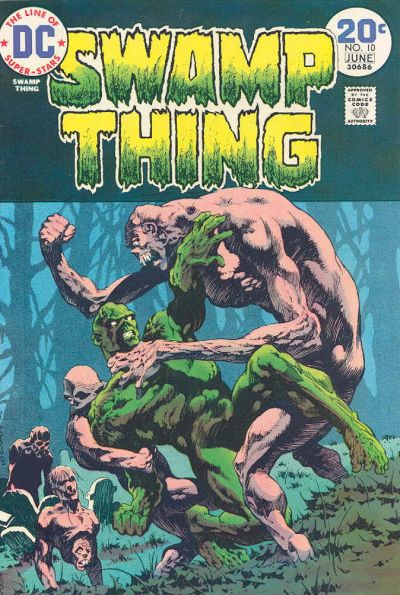
For Comic Books, it was Swamp Thing #10…

Image result for swamp thing #10

What I didn’t know when I bought that book at a drug store waaaaaaay back when was that this would be the last time Berni Wrightson illustrated his co-creation.

The book mesmerized me and made me realize comic books, like movies, like TV shows, and like books, could be works of art. It took me several years but over time I managed to get the other 9 issues of the run and found the pairing of Len Wein’s writing and Berni Wrightson’s illustrations among the absolute best runs of ANY comic book series.  To this day, it remains one of my very favorites.

When I managed, after a while, to work in the comic book field for a few years, I attended a North Carolina convention and, much to my regret, didn’t attend a “professionals” party given that first night. It proved to be my one and best chance of meeting Mr. Wrightson and, alas, I blew it.

Mr. Wrightson’s works had a HUGE influence on me and, to this day, Swamp Thing #10 remains my all time favorite comic book ever.

Rest In Peace, Mr. Wrightson.

While I’m sure many lavished you with praise for your work and your illustrations for Frankenstein are probably remembered the best by the most, it was your work on Swamp Thing that will forever remain in my mind.

On my radar…

Over at Salon.com Max Cea reviews the documentary American Anarchist.  The film, directed by Charlie Siskel (he is the nephew of movie critic Gene Siskel), focuses on William Powell, the man who in 1971 published the very controversial book The Anarchist’s Cookbook.  The review of the film can be found here:

American Anarchist contends with the deadly impact of a writer’s words

I’m incredibly fascinated with the subject matter.

Back in High School, I recall at least one fellow dorm dweller having a copy, though I suspect it wasn’t so much that the person who had it fancied themselves an anarchist but rather they wanted to own this controversial book.  In the book, Mr. Powell, who wrote it when he was 19, weary of the Vietnam War, and held a “radical libertarian’s” viewpoint, offered a manual of how to make DIY explosives/weapons and drugs.

Mr. Powell is now 65 years old and, according to the review, was not aware of the “influence” this tome has had over the years, including being found among the possessions of the Columbine shooters.

According to the review:

(Mr. Powell) has publicly denounced the book’s message and argued for it to be taken out of print. “Over the years, I have come to understand that the basic premise behind the Cookbook is profoundly flawed,” he wrote in a 2013 Guardian op-ed. “The anger that motivated the writing of the Cookbook blinded me to the illogical notion that violence can be used to prevent violence.”

Further, the review notes Mr. Powell is not that interested in looking into his book’s connections to other acts of violence.  Though he clearly regrets the book and its contents today and wishes it was “out of print”, I get the feeling from the review that Mr. Powell feels the publication of the book is not unlike a gun-maker producing weapons which subsequently are used for violence.  The defense is the old “guns don’t kill people, people kill people” cliche.

I’m very likely simplifying things as Mr. Powell no doubt holds his own views and I cannot get into his mind.  Nonetheless, the documentary intrigues me.

I certainly feel for Mr. Powell as 1971 was a rough time to be a 19 year old.  With the Vietnam War raging and the draft still in effect, the idea of going overseas to fight -and possibly die- for what many considered by then a worthless war must have created a tremendous strain in many people of Mr. Powell’s age.

His book, created at the height of these very harsh times, will likely be his life’s legacy and it must bother him that a book he now wishes was “out of print” remains out there and, possibly, influencing minds if not actions.

As someone who writes, this proves to be a cautionary tale.  Whatever you choose to write and publish might linger for many, many years beyond the time of publication and if you’re forward thinking you may want to carefully consider this before releasing something into the general public.

It is possible to regret your words.

The Winds of Winter…coming?!

If you were today, Tuesday, March 7th 2017, to look at the literary field and pick out some of the bigger names/books around, you’d likely list, among others, the works of Stephen King or J. K. Rowling.  Perhaps, today, you might be in the mood for Neil Gaiman or James Patterson.  I hear George Orwell is making quite a comeback, too.

(I’d love to include myself in this list…perhaps one day?)  😉

Another very big name on the list is George R. R. Martin.  His Game of Thrones fantasy series became red hot -and positively volcanic- after HBO started their adaptation of the series.

Most of you who are fans of Mr. Martin’s books know all too well that the HBO series has already leaped over the last of Mr. Martin’s published novels and will very likely end well before the final book in the series is released.

If it is ever released.

There are those who are growing increasingly pessimistic about the chances of the series ever being published/finished.  Currently, fans await The Winds of Winter, the sixth book in the seven book series and that means there remain two books to be released while it looks like HBO will finish the storyline -granted, one which is their own at this point though they did consult with Mr. Martin as to where he intended to go with the story- well before the last book is released and possibly before the second to last book is released.

Amusingly, Mr. Martin is still involved in other literary properties he’s started up, including the superhero universe of the Wild Cards.  On February 28th he tweeted about the publication of the latest Wild Cards book and that earned him this amusing rant by Patrick Redford theconcourse.com:

F#$k off, GRRM!

Mr. Redford’s very small post essentially wonders where The Winds of Winter is and why this Wild Cards novel is even being announced.

Let me tell you, I see Mr. Redford’s point.  I’ve been a fan of book series and there is nothing more infuriating than waiting for an author to finish up a series.  It’s almost as frustrating as starting a series and then finding it fades away over time.  For example, I was really, really into David Weber’s Safehold series (currently running 9 books worth, which is apparently the entire first “big” story line) but after four books and what appeared to me to be minimal advancement, I jumped off that particular boat.

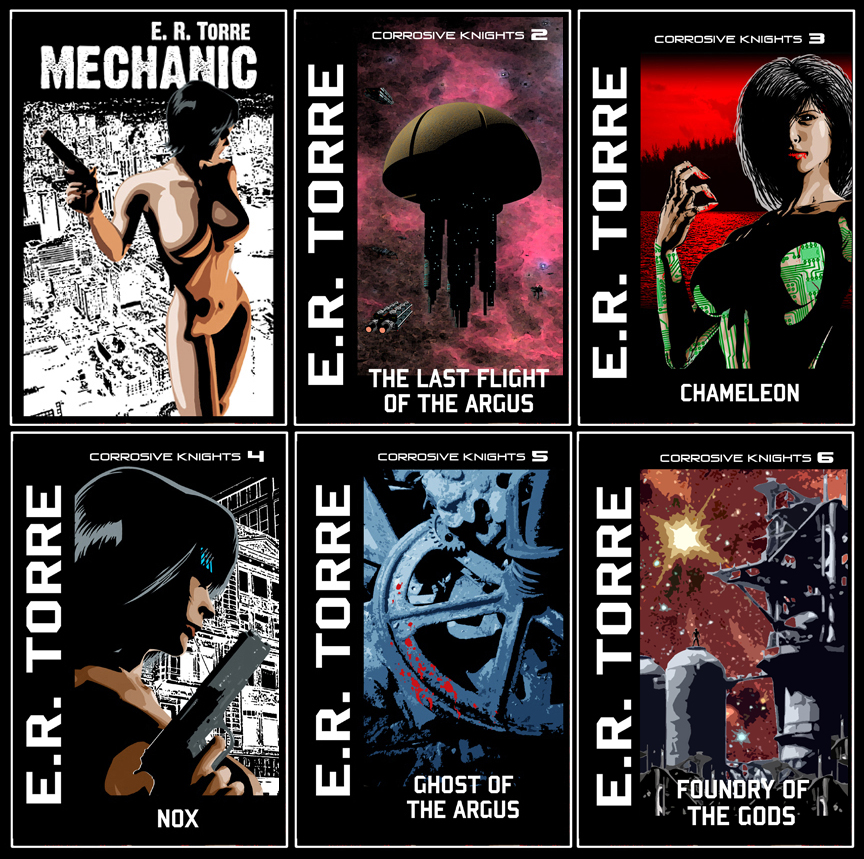
With my Corrosive Knights series, which in the end will run eight books long, six of which are now available, I’ve tried mightily to a) give readers something new and interesting with each new book and b) not overstay my welcome.

Because I’ve experienced both the writer’s and the fan’s side of getting into a novel series, I can certainly sympathize with Mr. Redford and the many who are impatient to read the next Game of Thrones book but, likewise, can sympathize with Mr. Martin as well.

The fact of the matter, and I’ve mentioned this many times before, writing a novel is not an easy task.  In my case it takes incredible concentration and patience.  How many of you out there can write a 100,000 page (or longer!) work, then spend many, many months revising and re-revising and re-re-revising this same work until you’re satisfied it is ready for release?

In my case, I’m writing alone.

In Mr. Weber’s case (and I suspect Mr. Martin’s as well), I’m certain he has staff to help him keep names and characters in some kind of order.  Even so, these are books filled to the brim with at times hundreds of different characters and getting everything to “work” in the course of the story is not an easy task.

And let’s face it, some suspect its not made any easier when, like Mr. Martin, you’ve probably already made more money than you’ll ever spend on the success of both the novels and the HBO series.

Why bother finishing up the series, they may wonder, when its being done for you?

I can’t speak specifically for Mr. Martin but I will say this: If my Corrosive Knights series was a successful HBO show and I was down, as I currently am, to the last two books in that series and it was looking like the show would “beat me to the punch”, I’d still finish the two books I was working on.

Writing for me is a part of my being and its impossible to stop.  Further, I don’t have everything all worked out.  New ideas pop up and I can’t help but wonder when/if the last two Game of Thrones books come out they prove to be very different -moreso than anyone thought- to the HBO series.

If I had the entire story line of Corrosive Knights already planned out to the smallest detail, trust me when I say that the series would have been done years ago.

I suspect the same can be said for Game of Thrones.

On Writing…technique: Simile

A few days ago I examined literary techniques via a book that was advanced to me (you can read the article here).  I provided an example of a passage in the novel and why it was problematic to me as it was in the middle of an action sequence and focused on something that didn’t advance that chapter’s main purpose: To build suspense.

Now, let me get into another literary element: Similes.

What are similes?  A full description and definition is offered in the link below:

Simile: Examples and Definitions

To spare you clicking the above link, here are some examples of similes:

He collapsed like a bag of potatoes.

The car wheezed as if a severe asthmatic.

The gunfire was like a series of explosions.

The bottom line regarding similes is that you compare something with something else, usually using the word “like” of “as” to make the comparison more direct.  The purpose of this is to give you an idea of the degree of the item(s) being compared.

Taking the above examples, the person didn’t just fall to the ground, he did so “like a bag of potatoes”, ie with great force and complete chaos.  The car wheezed like a severe asthmatic because that implies not only a failing motor, but one that is dangerously failing.  The gunfire wasn’t just loud, it was explosive loud.

Got it?

Good.

Now, and at the risk of having someone point out my own hypocrisy: I really don’t like using similes, at least for “serious” writing.  And it’s fair to say up to this point most of my writing has been fantastical but relatively “serious”.

Yes, I’m certain I’ve used similes in the past.  I don’t doubt that if someone goes through all my past writings they will find examples of me using them.  But I really don’t like them.  I really, really, don’t like using them.

Why?

In part its because most of the times similes are incredibly lazy.

I mean, how many times have you read about someone falling “like a sack of potatoes”?  Or that gunfire being like “explosions”?  Or how about these, presented as examples in the link above: Something being “as dry as a bone” or someone being “as cunning as a fox”?

Blah.

But there is another big reason for my lack of enthusiasm for the literary device and it involves, of all things, the Naked Gun films of Jim Abrahams and David and Jerry Zucker.

Bear with me here.

Starting in the late 1960’s and going through the 1970’s, disaster films were all the rage.  You had the “classics” like The Towering Inferno and The Poseidon Adventure (which, btw, featured a cameo appearance by one Leslie Nielsen).  These gave way to bigger and bigger disaster films like Earthquake and Roller Coaster and The Swarm and Beyond The Poseidon Adventure.

But one of the bigger “disaster” hits in the 1970’s were the Airport films.  The first movie, released in 1970, featured a huge, all star cast and was an equally huge hit.  It was followed by Airport 1975, Airport ’77, and The Concorde: Airport 1979.

In 1980 the above mentioned Abrahams and Zucker Brothers released the classic comedy Airplane! which parodied the living hell out of the “airliner in distress” movie genre.  However, I would argue the film also took great glee at parodying all disaster film tropes.

So good was the film at pointing out the many absurd cliches in airplane/disaster films that if you look carefully at the films released post Airplane!, you’ll see that the airline disaster film was all but gone for years afterwards (though some may argue The Concorde: Airport 1979 didn’t help the cause) and that big scale disaster film also were much more muted as well.  Sure, there have been disaster/airline-type films released since but they haven’t ruled the box office quite like they did up to that point.  In fact, the only big successful disaster film I can think of in recent days is probably the original Independence Day.

Jim Abrahams and the Zucker Brothers would go on to make the Naked Gun films and within them, at least to me, they laid a similar wrecking ball to the use of similes, something which was a commonly used literary device in the type of crime drama the Naked Gun films so beautifully parodied.

Here are the biggest/most hilarious lines, IMHO, featured in the three Naked Gun films:

Like a blind man at an orgy, I was gonna have to feel my way out.

Like a midget at a urinal, I was going to have to stay on my toes.

I like my sex the way I play basketball, one on one with as little dribbling as possible.

As Airplane! did with airliner/disaster films, these twisted -and hilarious!- similes affected my writing.  As much as I may want to use a “serious” simile in a passage, when I use the word “like” in comparing one thing to another I can’t help but recall one of the three above lines.

If I were writing a comedy, these lines would be inspiration.  But for “serious” writing?

Nah.

On Writing…technique

The other day I received, unsolicited, a Kindle copy of a book currently available through Amazon.com.  The reason the author (or his representatives) sent out the book to me was not because he/they knew I was an author but because I reviewed a book on Amazon that they thought was similar enough to their book that it would appeal to me.  They were hoping I’d read and write a review for their book and post it to the book’s listing on Amazon.

I can understand the reasons for him/them sending me the book.  The more reviews a book has, and especially if the reviews are positive, the more “popular” it appears to the casual book buyer and, hopefully, the better the chance more people will purchase said book.

I looked at the offered book but found it not all that interesting to me.  There was nothing wrong with the book’s plot, per se, its just that the story wasn’t my proverbial “cup of tea”.  I checked its listing on Amazon and sure enough it had quite a few reviews and, for the most part, they were positive.  I must admit, sending out copies of your book to people who have offered written reviews is something to consider and may well be helpful in getting a boost on your review numbers (By the way, thus far I’ve gotten more reviews on Goodreads than through Amazon.  The six books in my Corrosive Knights series are currently clocking in at -and I’m very proud of this fact- 4 stars out of 5).

Anyway, out of politeness to the author I decided to give the first chapter of this book a try.  Alas, it solidified the fact that this book wasn’t for me.  Further, having written as much as I have, certain technical aspects of the author’s work stuck out…negatively.

Out of deference to the author, I will neither name him or the book he was writing but I will provide some examples of things I found bothersome.

To begin, the book is advertised as a James Patterson-like thriller.  In reading the first chapter, which is a setup for what follows, the author presented an action scenario that took place in a famous location and one he took pains in describing.  Some authors like to do this.  If a book is set, say, in a particular neighborhood in London an author may go out of their way to provide readers a detailed geography of the land.  To some this may be quite fun but to me there is a fine line between offering this type of information and getting a little too focused on geography to the point where one loses the steam an exciting action scene should have.

While this author didn’t go overboard with descriptions he got, IMHO, awfully close.  Again, this is a matter of personal opinion: I like my stories to move and I don’t like to dwell too much on ancillary things or too much description.

When writing, one of the things I’ve learned is that you should constantly be focusing on telling the story as best as you can.  Each sentence and, indeed, word builds your story because every word counts.

Let me offer one sentence from this first chapter of the book and offer a critique of it.  Please note the sentence is just one sentence and does not represent the bulk of hte chapter I read (though to be fair, there were other things I found to be bothersome here and there).  Finally, this sentence is NOT presented completely verbatum as, again, I’m keeping the author and the novel secret.  Nonetheless, the below sentence is very, very close to an actual sentence in the book:

“Stop or we’ll be forced to use stronger measures!” yelled the senior officer in Spanish, who sported a five-o’clock shadow on his chiseled face.

This sentence, as written, is very clunky.  A better way to state the same information is:

“Stop or we’ll be forced to use stronger measures!” the senior officer, who sported a five-o’clock shadow on his chiseled face, yelled in Spanish.

While better this sentence is still not all that good.  By the time we read this passage, we already knows the country this part of the story takes place in and therefore should know the language spoken by the “senior officer”.  Thus, in the interests of brevity, the sentence could have gone like this:

“Stop of we’ll be forced to use stronger measures!” the senior officer, who sported a five-o’clock shadow on his chiseled face, yelled.

Better yet still not great.  I strongly suspect the “senior officer” presented here is a very small character whose only appearance in this novel is right here (I can only suspect this because I haven’t read the rest of the novel).  I know and can appreciate the author wanting to give this small character some kind of “life” in this brief appearance but the “five o’clock shadow” and “chiseled face” is at best a rather obvious descriptor and at worst a very cliched one.

Given the likelihood this is the only appearance of this character, his facial description isn’t as important as his purpose, which is to be a menace to the one he’s shouting at.  That being the case, instead of focusing on the character’s face perhaps it would have be better to focus on the threat he conveys.  How about this:

“Stop or we’ll use stronger measures!” the senior officer shouted as his right hand reached for and gripped the gun strapped to his side.

I make absolutely no pretenses about literary mastery here and acknowledge what I wrote ain’t quite Shakespeare or Hemingway but on the other hand this sentence is better at getting to the heart of what this character’s purpose is:  To impart a sense of threat/danger to the character he’s yelling at.

Writing a story, whether it be short or long or massive involves an incredible amount of thought on the part of the author.  Every word counts and you should try to maximize what you write.

This is not an easy task!

I’ve mentioned before that it took me 12 drafts before I was happy enough with my last two novels to release them.  The reason for these drafts is because I too struggle with making sure what I’m writing is as good as is possible.

I took great pains to not point out who this author is or what book he’s promoting and the reason for that is because it is unfair to do so.  I’m just as guilty as he is, perhaps even more so, of writing clunky sentences or not focusing on elements that should be focused on as I made an example of above.

Not every time you go to bat do you hit a home run.  Sometimes, you’re lucky to just get to first base without striking out.

Corrosive Knights, a 2/27/17 Update

It’s been a little while since I’ve provided an update on the Corrosive Knights series and, specifically, book #7 in the series.  This book concludes the main story line (though there will be a book #8, an epilogue, to the series).

So, what’s the news?

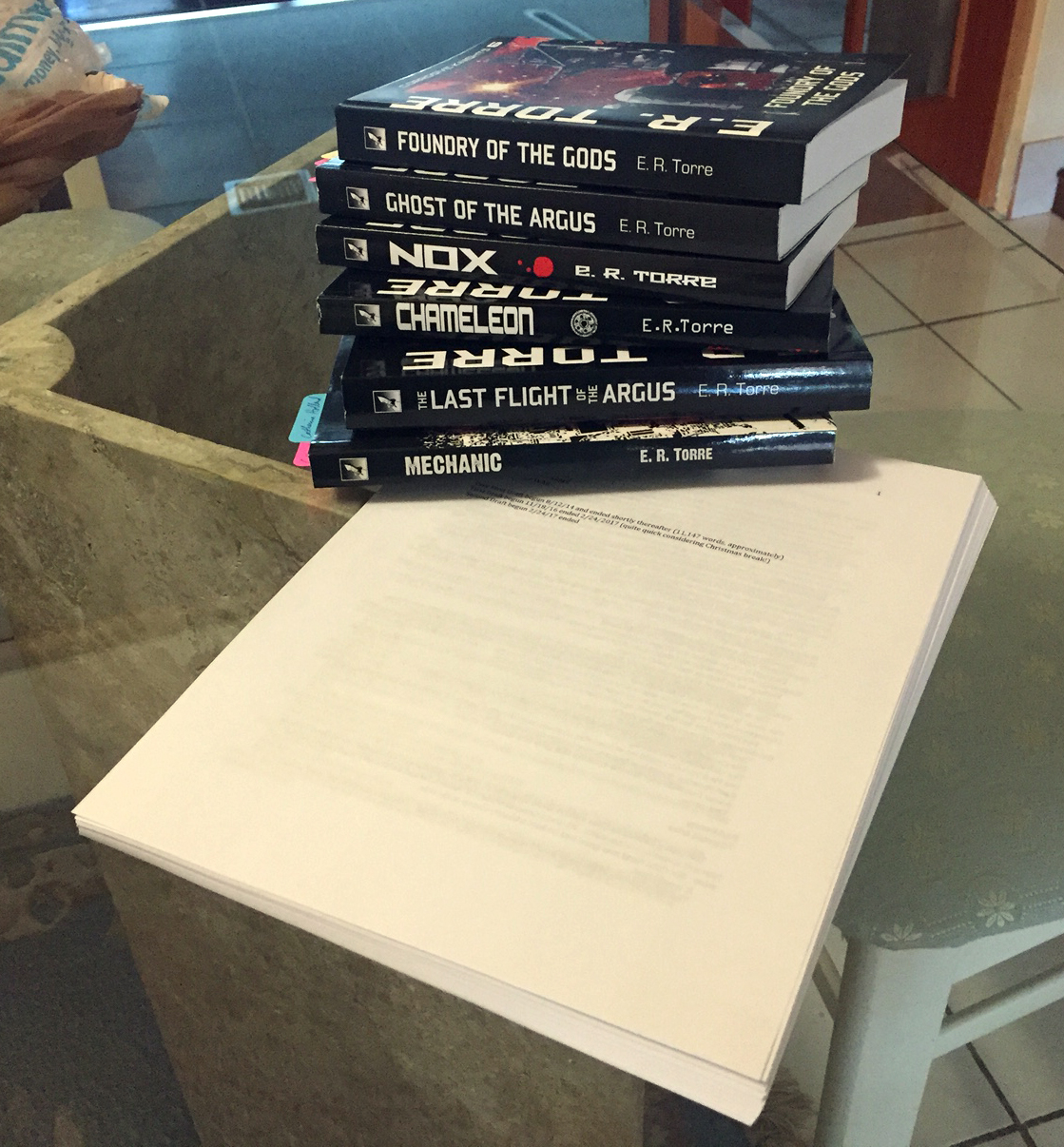
What you’re seeing in this photograph and lying underneath the previous 6 books in the Corrosive Knights series is the finished first draft of Book #7.  On Friday, February 24, I finished that first draft and printed it out so that I could get to work on the second draft.

Mind you, the first draft of this novel, as big an accomplishment as it is, is nonetheless still far from the finished work.  I’ve mentioned before how my two previous novels, Ghost of the Argus and Foundry of the Gods, required 12 drafts before I was happy with the overall product and deemed it good enough to be released.

However, let’s not rain on this particular parade: The fact that I’ve gotten to the point where I’m happy enough to print out this first draft, and it is as complete as it is, fills me with optimism that this novel will not take quite as long to finish as those last two books.  Bear in mind I started this novel in mid-November, worked through roughly half of December (vacations and kids coming home inevitably meant less work being done), then January and February.

To get a first draft of a novel done in what amounts to approximately three months -give or take- is extraordinary and bodes well for the book’s eventual completion and release.

Of course there are still plenty of things needed to be done.  The first draft clocks in at approximately 66,000 words yet I’m certain when all I get to that final draft this novel will be north of 110,000 words.  This means there are maybe 50,000 more words left to write.  Where will the bulk of these to-be-written parts come from?  From a subplot I decided to sketch out while sticking to the novel’s main plot in this draft.

Regardless, I’m incredibly excited by the book’s progress and intend to hit the gas hard in the coming months.  Will I get the novel done before the year is over?

Hard to say as I’m still so early in the book’s process but I’d be lying if I said I didn’t hope so.

Wish me luck!

On Writing…getting the plot

Yesterday was a particularly good day for my work on the latest Corrosive Knights novel (this will be book #7 and will conclude the main story I’ve been working on for nearly a decade now).

Why was it a particularly good day?  Because as I was thinking the novel’s plot over (something I tend to do with my latest works all hours of the day), the synapses in my brain figured out a way to bring various elements of the beginning and end of the novel together and in a matter of a half-hour and while on the computer I created a beautiful, exciting outline of the bridge linking the two ends of the book.

Mind you, I came up with some far rougher general ideas as to what was going to happen in the middle of the book before but those thoughts were far less complete than what I came up with yesterday.  Indeed, yesterday I filled almost all of the gaps of that middle section of the novel and this will obviously be a tremendous help.

I’ve written about this before but it bears repeating: Authors, like all working people, have their strengths and weaknesses and likes and dislikes.  I’ve heard of authors who have a tough time “beginning” a novel.  I’ve heard of authors who have difficulties wrapping things up.  Indeed, one of the greatest complaints I’ve read against Stephen King’s work (I only wish I could write as much as he does!) is that his novel endings tend to be weak.

For me personally, starting and ending a novel hasn’t, to date, been all that much of a problem.  In fact, whenever I start a new novel I tend to have strong opening and closing ideas.

Where my problem lies is in providing the tissue connecting those two elements.  Further frustrating me is the fact that I strive to make my novels as original as I can and want readers to be surprised by the twists and turns leading to my novels’ endings yet everything must come together by that ending.

Trust me, that’s not an easy task!

Throughout my life I’ve sought out interviews with noted authors about what motivates them and how they work.  Some authors revel in what I consider a “mythological” take on their writing.  To them, writing may be described as akin to creating “magic.”  I’ve read more than one author talk about how their fictional characters take charge of the story and dictate its direction, as if this fictional character the author’s created has taken hold of the story being told.

I think a lot of that is bunk.

I know I’ve said it before but writing is, first and foremost, work.  Plain and simply.  In my case this work can be very hard and mentally exhausting.

On TV, shows like Murder She Wrote and Castle present a fiction of an author who seems to do their writing in their spare time, creating their “best sellers” in a matter of a few hours while otherwise living a fabulous, carefree life.

The reality, at least for me, is one of almost obsessive mental concentration.  Though you may not believe it, I do indeed spend almost every waking hour thinking of my latest novel/story.  I don’t think a minute passes where some part of my brain isn’t obsessing over some detail, big or small, within my latest work.

The thing is, while I tend to get the opening and closing acts of my works out of the way pretty quickly, that middle connective section requires a great deal of care and thought and, to date, I’ve yet to have a middle section of my book come to me as “easily” as my novel openings/closings.

Regardless of all the work involved, I freaking love creating stories.  As difficult and as frustrating and as time consuming and as un-sexy as the act of creation may be, when all that hard work is done and I hold in my hands my latest novel and then add it to the stack of novels I’ve already written, I’m in heaven.  It is as pure a moment of pride and unadulterated joy as I can have.

And I can’t wait to get to work on the next one.

The A.B.C. Murders by Agatha Christie (1936), a belated review

I admire the hell out of author Agatha Christie.  In her lifetime she released an almost obscene amount of novels (66) and short story collections (14) many of which, today, are considered classics in the crime/mystery genre.

During her lifetime she also created not one but two very famous “sleuths” to inhabit many of her novels.  The more well known of the two, Hercule Poirot (the other is Miss Marple), appeared in 33 of those 66 novels and some 50 short stories.  Like Sir Arthur Conan Doyle’s Sherlock Holmes, Hercule Poirot is a detective with an intelligence that is superior to those around him.  He makes all the connections between crime and murderer and solves crimes that leave all others baffled.  Curiously, also like Sir Arthur Conan Doyle, Agatha Christie grew to hate the character of Poirot, though unlike Mr. Doyle reserved the “last” Poirot case, Curtain, for release in 1975 (Mrs. Christie would pass away in 1976).

Over the Holidays, Amazon.com offered many books for sale.  Among them were several Agatha Christie novels, some of which I read and others which I didn’t.  I think I read her 1936 Poirot novel The A.B.C. Murders many, many years ago.  However, if I did, I recalled no details so reading this book was, essentially, like reading it for the first time.

The ABC Murders: A Hercule Poirot Mystery (Hercule Poirot series Book 13) by [Christie, Agatha]

The book is the 13th to feature Mr. Poirot in the lead and it is an interesting book to read, though because of my familiarity with Mrs. Christie’s writing style I found some of the bigger surprises not quite as surprising, I suspect, as most virgin Agatha Christie readers might find them.

To begin, the mystery presented is different from some of the usual Agatha Christie affairs.  Hercule Poirot, living in London, receives a strange letter from someone who signs it “A.B.C.”  The person states s/he will kill someone in a certain town (the town’s name begins with the letter “A”) and dares Hercule Poirot to find and stop him/her.

The police wonder if the letter is written by some crank and Hercule Poirot hopes this is the case while clearly worried it is not.  To make a long story short, a murder is committed and the victim’s last name also begins with an “A”.  Then a second letter arrives, indicating the next victim, who will have a “B” in their last name, will be found in a town that begins with the letter “B”.

What’s fascinating about this novel is that many of the Agatha Christie novels I’m familiar with tend to be murder mysteries revolving around a set of characters and this novel and this one hints at the possibility of Hercule Poirot going up against a serial killer.

What is even more fascinating, I found, is that at one point Mr. Poirot states something along the lines of wanting to get into “the killer’s mind”, a big plot device used very effectively nearly a half century later by Thomas Harris in his Red Dragon and Silence of the Lambs novels, both of which were eventually made into very good movies (I refer to the Michael Man directed Red Dragon adaptation Manhunter rather than the remake done post Silence of the Lambs).

As I read the novel, I was fascinated by how well Mrs. Christie writes.  She manages to say a lot with very little, often allowing the dialogue to propel the story along and giving us tasty hints as to what characters are all about.  I particularly enjoyed the way the character of Thora Grey was presented.  MILD SPOILERS In the end, the character was revealed to be a gold-digger and her plans fell by the wayside.  I suspect in other author’s hands the character would have been presented as much more nasty but Agatha Christie manages to show us the relative good in her even as she’s revealed to be a calculating woman.

Unfortunately and as I mentioned above, being familiar with Agatha Christie’s writing style, some of the bigger surprises the book offers didn’t surprise me as much as I would have hoped, though I would easily recommend this book to anyone interested in sampling Mrs. Christie’s novels.

To get into that, I’m going to have to get into some bigger…

SPOILERS

Still there?  Again, if you want to read the novel, I strongly urge you to look away from what I’m going to talk about.  Beware!

Still there, redux?

You’ve been warned!

The A.B.C. Murders tries to make us think we’re dealing with Hercule Poirot going up against a mad serial killer yet almost from the very first page I knew there had to be more to the story.  Again, I may have read the story before many, many years ago, so maybe its not so much that I’m clever but rather that I had details of the plot buried deep in my subconscious.

Regardless, from the moment we deal with the idea of a possible mad serial killer taunting Hercule Poirot, I somehow knew the murders he’d face were a distraction and that this whole effort to present the idea of a serial killer was, in reality, an effort to hide one particular murder.

Once you’ve put yourself in that frame of mind, as I did early in the novel, it was clear which of the murders (there are four in total), was “the” one.  It was easy to figure out as it was the murder that others had the most to gain from.  As in money.  Three of the victims came from simple means and one was a wealthy person who would leave behind quite a bit of money.

Once I determined the murders were a diversion, and this was well before that victim was named, I started looking for the clues to whodunnit and why.  It became a simple bit of deduction on my part and there were only two possible candidates for the role.  However, this was also where parts of the novel started to stretch credulity.

The idea of presenting us with a bogus “mad” killer is all good and well, but when you have an actual character presented in the book who is being framed for this, a character who is absolutely perfect for the frame (he’s a WWI vet who suffers from blackouts and therefore isn’t even certain if he committed some of the crimes), you begin to wonder just how much free time the real murderer had to a) find the patsy, b) plan out the elaborate charade, and c) commit the actual murders without being found out until getting to the one that was the true victim.

As entertainment, The A.B.C. Murders is nonetheless an enjoyable, entertaining novel whose biggest flaw is that it hopes readers will accept all the above and not question it…at least not too much.

While at times preposterous because of this, The A.B.C. Murders is nonetheless worth checking out.